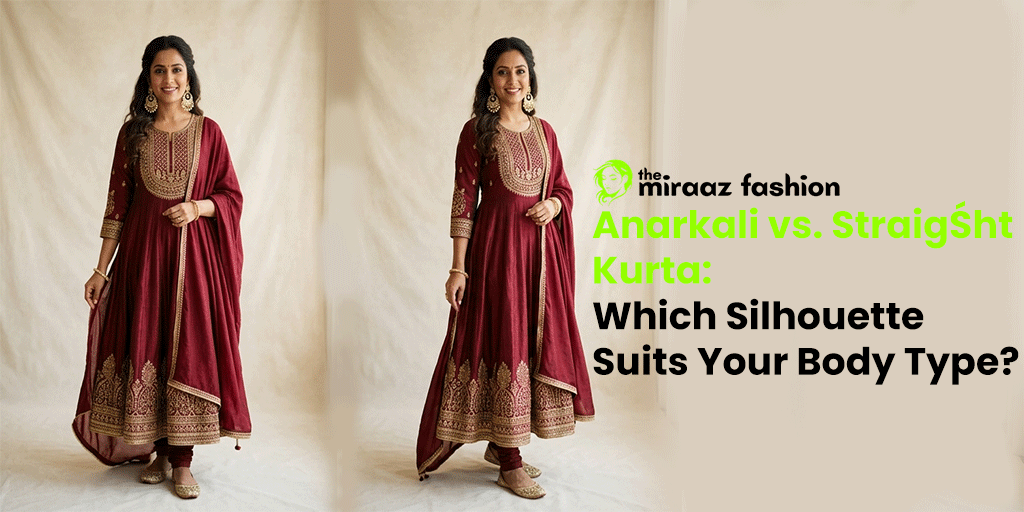

Anarkali or straight kurta — which is better for your body type?
| Body Type | Best Choice | Why |
|---|---|---|
| Apple | Empire-waist Anarkali | Flares from below bust, skims the midsection |
| Pear | Flared Anarkali | Covers hips naturally, add upper-body detail |
| Hourglass | Fitted-bodice Anarkali | Shows natural waist before flaring |
| Rectangle | Layered Anarkali | Creates the illusion of curves |
| Inverted Triangle | Straight kurta | Adds length, avoid adding volume on top |
| Petite | Knee-length straight kurta | Avoids visual shortening from heavy flare |
The core rule: Anarkali adds volume and drama below the waist. Straight kurta creates vertical length and structure. Once you know what your body needs, the choice becomes obvious.
What Is the Real Difference Between an Anarkali and a Straight Kurta?
Most people choose between these two based on what looks nice on the hanger. That’s why so many kurtas end up unworn.
An Anarkali adds volume and movement below the waist. The flare — whether it starts at the empire line (below the bust) or at the natural waist — draws the eye downward and outward. It creates curves, hides the hip and thigh area inside the flare, and gives a dramatic, occasion-ready silhouette.
A straight kurta creates vertical length. The uniform width from shoulder to hem creates a clean vertical line that makes you look taller and slimmer. It defines the silhouette without adding volume anywhere. It’s structured, polished, and versatile for everyday and office wear.
Once you know this, you’re not guessing anymore. You’re matching.
Related: If you’re also looking at how to style different Indian outfits for each occasion, read our guide on how to style a kurta set for every occasion — from daily wear to parties.
How Do I Find My Body Type in 5 Minutes?
You don’t need a professional measurement session. Just grab a soft measuring tape.
Measure three things:
- Bust — the fullest part of your chest
- Waist — the narrowest point, usually just above the navel
- Hips — the fullest part, usually about 8 inches below the waist
Now compare the numbers:
- Apple shape: Bust and shoulders are wider than hips. Weight sits in the upper body and midsection. Waist is not the narrowest point.
- Pear shape: Hips are noticeably wider than bust. You have a defined waist. Weight sits in the lower body — hips, thighs, bottom.
- Hourglass shape: Bust and hip measurements are close (within ~2 inches). Waist is significantly narrower — at least 8–10 inches narrower than both.
- Rectangle shape: Bust, waist, and hip measurements are close to each other. Minimal curve definition. Lean, straight frame.
- Inverted Triangle: Shoulders and bust broader than hips. Wider at the top, tapers toward the bottom.
Got your shape? Now let’s match it to the right silhouette.
Which Kurta Is Best for Apple Body Type?
Direct answer: An empire-waist Anarkali works best for apple body types. The flare starts just below the bust — the slimmest point — and flows freely over the midsection without clinging.
Anarkali for Apple Body Type
The empire-waist Anarkali is your strongest option. Why? The flare begins before the midsection, so the fabric never clings to the stomach area. The visual effect makes the waist look defined even when the fabric is flowing freely.
What to look for:
- V-neckline or a deeper round neck — draws the eye upward to the face
- Embroidery or decorative detail at the chest or shoulder level (not at the waist)
- Solid dark or medium tones, or small prints
- Avoid heavy embroidery at the waistband — that draws attention to the widest point
Straight Kurta for Apple Body Type
A longer straight kurta (knee to just below the knee) with vertical pintucks, a centre placket, or vertical embroidery lines works well. Vertical details elongate the appearance. Pair with cigarette pants or straight-fit churidar — not palazzo or wide-leg pants, which add horizontal width and widen the silhouette.
What to Avoid
Any kurta — Anarkali or straight — with a broad contrasting waistband or thick belt sewn at the natural waist. This cuts your body at its widest point and makes the midsection appear more prominent.
Related: Want more tips on dressing for your shape? Our detailed guide on how to look slim in dresses covers 12 styling tricks that actually work for real Indian body types.
Which Kurta Is Best for Pear Body Type?
Direct answer: A flared Anarkali is the best silhouette for pear body types. It skims over the hips and thighs without clinging and naturally creates visual balance between the upper and lower body.
Anarkali for Pear Body Type
The flare of an Anarkali naturally covers the hip and thigh area without the fabric pulling or bunching. But the most important detail most people miss: choose an Anarkali with upper-body interest.
This means embroidery, print, or decoration at the chest, shoulder, or neckline level. Cold-shoulder styles, boat necks, or wide square necks add visual width to the upper body, bringing proportions into balance. The more interesting the top half, the more balanced your overall silhouette looks.
Avoid: Anarkalis where all embroidery and decoration sits at the hem or the lower flare — that decoration sits right at your widest point and emphasizes it.
Straight Kurta for Pear Body Type
If you prefer straight kurtas, go for a slight A-line cut — one that’s fractionally wider at the bottom than at the top. Avoid straight kurtas that are cut tight or even medium-fitted through the hip area. The fabric should skim, not pull. If it’s pulling horizontally at the hips, it’s the wrong size or cut for your frame.
Which Kurta Is Best for Hourglass Body Type?
Direct answer: Both silhouettes work for hourglass figures, but the most common mistake is choosing clothes that hide natural curves entirely. Choose fitted-bodice Anarkalis and slightly shaped straight kurtas.
Anarkali for Hourglass Body Type
Choose an Anarkali with a fitted bodice. The upper portion should hold the shape of your bust and waist before flaring out below. Avoid Anarkalis in very stiff, structured fabrics that don’t follow the body’s natural curve — these create a box-like shape that erases your waist.
Best fabrics for hourglass Anarkalis: Georgette and chiffon drape beautifully. Raw silk gives a more structured look for formal occasions.
Straight Kurta for Hourglass Body Type
A completely boxy straight kurta will make your figure look shapeless. Choose one that’s slightly fitted through the bust and waist — not tight, but body-following. If you find a straight kurta you love but it runs boxy, a thin belt tied at the waist (over the kurta) instantly creates waist definition and transforms the look.
Which Kurta Is Best for Rectangle Body Type?
Direct answer: An Anarkali is the better choice for rectangle body types. The flare adds visual volume at the lower body, creating the illusion of curves and hips where there is less natural definition.
Anarkali for Rectangle Body Type
Look for Anarkalis with layered frills at the hem, heavy embroidery at the bottom, or a peplum-style waist detail. These elements create the impression of curves and make the silhouette more dynamic.
Important: Avoid stiff, flat fabrics. Fabrics with natural movement — georgette, chiffon, soft silk — make the flare look intentional and elegant. A stiff fabric just hangs straight and defeats the purpose.
Straight Kurta for Rectangle Body Type
If you prefer straight kurtas, the trick is in the pairing. A plain straight kurta alone will look one-dimensional on a rectangular frame. Options that work:
- Add a wide-leg palazzo or flared skirt as the bottom to create lower-body volume
- Add a belt over the kurta to create a visible waist
- Choose kurtas with ruffled necklines, puff sleeves, or bold chest embroidery to add dimension to the upper body
Which Kurta Is Best for Inverted Triangle Body Type?
Direct answer: A clean, minimal straight kurta is the best choice for inverted triangle body types. Keep the top simple and add volume through your bottom wear instead.
Straight Kurta for Inverted Triangle Body Type
Avoid embroidery, ruffles, or bold prints on the upper portion of the kurta. V-necks and scoop necks work better than boat necks, which visually widen already-broad shoulders.
Pair the straight kurta with: Palazzos, sharara-style pants, or a flared skirt — this is where you add your volume, in the bottoms rather than the top.
Anarkali for Inverted Triangle Body Type
If you want to wear an Anarkali, choose one where the flare begins at the hip level, not at the chest. An empire-waist Anarkali will add more volume to an already-wider upper body — the wrong effect. Instead, go for a natural-waist Anarkali with minimal shoulder or chest detail.
Avoid: Anarkalis with puffed sleeves, heavy yoke embroidery, or off-shoulder designs — all of these add visual bulk to the top half.
When Should You Wear an Anarkali vs. a Straight Kurta? (Occasion Guide)
Body type is half the decision. The occasion is the other half.
Wear an Anarkali for:
- Weddings, mehndi, sangeet, and engagement functions — the dramatic flare is occasion-appropriate
- Diwali, Navratri, Eid, and other festival celebrations
- Evening parties and semi-formal gatherings
- Cultural events and college fests where a visible, expressive look is welcome
Wear a Straight Kurta for:
- Office and corporate environments — a clean, structured silhouette reads as professional
- College, daily errands, and casual outings
- Travel — straight kurtas fold without heavy creasing and are easier to pack
- Temple and gurudwara visits — a simpler, modest silhouette is appropriate
When Both Work:
For family dinners, casual birthday gatherings, or informal house parties, both silhouettes are appropriate. In this overlap zone, let your body type guide be the deciding factor rather than the occasion.
Related: Planning to wear a kurta or outfit to the office? Our guide on best dresses for office wear — comfort and style will help you choose the right styles that work in an Indian professional environment.
Which Fabric Works Best for Each Silhouette?
The right silhouette in the wrong fabric looks wrong. Fabric is not secondary — it’s what makes the cut actually work.
Best Fabrics for Anarkali Kurtas
- Georgette and chiffon — the gold standard. Natural flow makes the flare fall gracefully. Best for weddings and formal occasions.
- Raw silk and art silk — more structured and formal. Good for wedding-adjacent events.
- Soft cotton — works for casual or festive daywear. Avoid very thick cotton — it makes the flare look like a tent rather than a gown.
Best Fabrics for Straight Kurtas
- Cotton and linen — ideal for Indian heat. Holds shape, breathes, and looks intentionally structured.
- Rayon — drapes slightly and stays comfortable through long days.
- Chanderi and Khadi — have a slightly luxurious appearance that works for both casual and semi-formal settings.
- Avoid: Very thin or clingy fabrics like georgette for straight kurtas — without structure, the kurta clings to everything.
Related: Not sure which fabric works best in Indian summers? We’ve compared all the major options in our guide on best fabrics for summer dresses — cotton vs satin vs chiffon.
How Do I Check If a Kurta Fits Correctly — Before Buying?
Most women try on a kurta, feel “okay” about it, and buy it — then it sits in the wardrobe. Run these four checks every time.
Step 1 — The shoulder seam test. The shoulder seam must sit exactly at the edge of your shoulder. Not falling down your arm, not pulling toward the neck. If the shoulder fit is wrong, nothing else can fix the kurta.
Step 2 — The chest ease test. Pull the fabric straight across your chest. There should be enough ease to fit two fingers comfortably between the fabric and your body. Tighter than that, it’ll pull when you move. Looser, it’ll hang open.
Step 3 — The movement test. Lift both arms above your head. If the kurta rides up dramatically or pulls across the back, the body length or width is insufficient.
Step 4 — The sitting test. Especially for Anarkalis — sit down in the changing room. The flare should spread around you comfortably. If it bunches awkwardly or the bodice pulls, the cut is not right for your proportions.
5 Common Mistakes to Stop Making Right Now
Mistake 1: Buying a size up to “hide” your body. Going up a size adds bulk everywhere and ruins the shoulder fit. Always buy your actual size and get minor alterations if needed. A small alteration makes a huge difference.
Mistake 2: Wearing the wrong dupatta with an Anarkali. A heavy or stiff dupatta with a flowing Anarkali weighs the outfit down and kills the grace of the flare. Use a sheer or lightweight dupatta — chiffon or georgette — or skip it if the neckline is decorative.
Mistake 3: Pairing a straight kurta with the wrong bottoms. A straight kurta with very wide palazzo pants on a petite frame overwhelms the silhouette. A straight kurta with slim cigarette pants on a pear shape makes the hips look wider by contrast. Match the width of your bottoms to your body type, not just to the kurta style.
Mistake 4: Ironing an Anarkali into stiffness. Anarkalis — especially georgette ones — should not be ironed directly at high heat. The flare is meant to flow, not look pressed and starched. Steam from a distance instead.
Mistake 5: Buying for the hanger, not your body. Kurtas look different on plastic hangers and styled mannequins than they do on real bodies in motion. Always try before you buy. Move around in the trial room. Don’t just stand still in the mirror.
Related: If you love the idea of getting more versatility from the same outfit, our guide on how to style one dress in 5 different ways shows exactly how to do it.
Quick Decision Framework — 3 Questions Before Every Kurta Purchase
Stop guessing at the store. Ask these three questions every time.
Question 1: What does this silhouette do to my specific proportions? Does the flare create balance or add volume where I already have it? Does the straight cut elongate me or make me look boxy?
Question 2: Where am I actually going to wear this? If the honest answer is “I’m not sure,” don’t buy it. Every kurta should have a clear occasion in mind at the time of purchase.
Question 3: Is the fabric right for this silhouette? The most beautiful Anarkali cut in a stiff, wrong fabric will not move the way it should. Always check the fabric drape before the design.
Get these three right and you’ll rarely buy a kurta that disappoints you.
Frequently Asked Questions (FAQs)
Can a plus-size woman wear an Anarkali?
Yes — an Anarkali is actually one of the most flattering silhouettes for plus-size women. Choose an empire-waist or natural-waist Anarkali in a flowy fabric like georgette. Avoid very stiff or structured fabrics that don’t drape. A V-neckline at the top adds an elongating effect.
Is Anarkali suitable for office wear?
Generally, no — a full-flare Anarkali is too dramatic for most Indian office environments. A straight kurta or a mildly flared kurta in a solid colour or subtle print is more appropriate. If your office is creative or fashion-forward, a midi-length Anarkali in a muted colour may work.
What is the difference between an Anarkali frock and an Anarkali kurta?
An Anarkali kurta is typically paired with churidar, leggings, or pants. An Anarkali frock (also called an Anarkali suit or gown) is a standalone dress-length garment with the same flared silhouette. The frock version is often more formal and used for wedding and function wear.
Can a petite woman wear a maxi Anarkali?
Yes, but with caution. A floor-length Anarkali can visually shorten a petite frame if it’s too heavily layered or has a very wide flare. A petite woman should choose a midi-length Anarkali (below knee to ankle) rather than floor-length, and pair it with heels to maintain height proportions.
Which straight kurta length is most versatile?
Knee-length straight kurtas are the most versatile — they work for both office environments and casual outings, pair well with leggings, palazzos, jeans, and churidar, and work across most body types.
Should I buy an Anarkali or straight kurta first if I’m building my wardrobe?
If you’re starting out, a knee-length straight kurta in a neutral or deep solid colour is your most versatile first purchase. It works for more occasions and is easier to style. Once you know your body type and what works for you, then invest in an Anarkali for occasions.
Can I wear a straight kurta to a wedding?
Yes — but style it up significantly. A straight kurta in a rich fabric (silk, chanderi, heavy embroidery) paired with a sharara or a flared skirt, statement jewellery, and heels can absolutely work for a wedding. Keep the kurta itself festive — not in daily-wear cotton.
Related: If you enjoy styling Indian outfits differently for different occasions, our complete guide on how to style a kurta set for every occasion covers daily wear, parties, functions, and more.
The Bottom Line
Anarkali and straight kurta aren’t competing options — they serve different purposes and different bodies.
The Anarkali gives you drama, flow, and the illusion of curves. It’s your go-to for occasions, for body types that want to minimise the midsection or add hip volume, and for any time you want your outfit to make a statement.
The straight kurta gives you structure, polish, and length. It’s your go-to for everyday wear, office settings, travel, and any time you want a clean, elongated silhouette.
Understand your body type. Understand what each silhouette does. The right choice becomes obvious every single time.